Monday, April 29, 2013

Sowing the Seeds of Disaster

There are still unanswered questions about the recent fertilizer plant explosion in West, Texas that killed 15 people and injured over 200. From what we do know, it seems that three key ingredients contributed to the tragedy.
First, lax regulation and oversight: the plant had not been inspected by the Occupational Safety & Health Administration since 1985 and had operated for two years without necessary air permits. Second, the inherent risks of a dangerous industrial process: there were 270 tons of potentially explosive ammonium nitrate on site. Third, the close proximity of people: schools, homes, and an apartment complex were just blocks away from the plant.
The scary thing for Denton is that all of these ingredients are falling into place when it comes to natural gas drilling and fracking. We need to take steps now to prevent a similar disaster here.
First, consider the ingredients. Lax regulation and oversight? Check. Oil and gas well inspections by the Texas Railroad Commission have actually been decreasing even as the number of producing wells has skyrocketed in recent years.
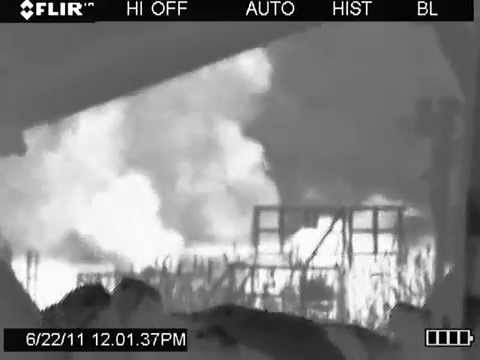
Inherent risks? Check. Just last week, EagleRidge lost control of a well off of Jim Christal Road not far from Denton Presbyterian Hospital. An incident report estimates the event released 59 lbs. of carcinogenic benzene into the air, but a home video suggests that figure is a gross underestimation. This is being called a ‘leak’ but it looks much more like a blow-out. Accidents will happen, either as a result of operator negligence or as a ‘normal’ feature of complex technological systems.
Proximity of people? Check. There are wells in town (like the one near Bonnie Brae and Panhandle) that are very close to homes and parks. City Council voted in January to increase the setback distance between wells and protected uses to 1,200 feet. But, due to vested rights, this new ordinance will not have much of an impact. Indeed, days after the EagleRidge ‘leak,’ Denton’s Planning & Zoning Commission approved a development plan off of Teasley Lane that will put homes just 100 feet from two gas wells.
And this is not an isolated incident. Most future drilling activity in Denton will occur under old rules with minimal protection standards for neighboring homes. On top of this, when homes are built around pre-existing wells, Denton’s ordinance allows a variance to be granted that can reduce the setback distance to 250 feet. The rationale for this is ‘buyers beware’ – prospective homebuyers are able to make an informed choice, because the well is already there. But of course, conditions are not ripe for a truly informed decision here. Realtors are often not knowledgeable on the subject. And developers barely disclose information about the risks posed by gas wells. Why would they, when it can mean millions in lost revenue?
The fertilizer plant in West was built in 1962 when it was surrounded by open farmland. But a boom of development brought homes and schools nearby. The same is going to happen in Denton as wells are developed in master planned communities such as Robson Ranch and homes come in later. There are stories from West of a creeping complacency about the fertilizer plant: it’s been here for so long, it’s not risky. A former City Council member admitted development decisions in West were pretty much on auto-pilot, saying of the potential threat posed by the plant “There was never any thought about it. Maybe that was wrong.”
We need to be vigilant and avoid this kind of thoughtlessness. Denton is currently revising its comprehensive plan, which opens a forum for thinking about this issue. Here, then, is a question we should think long and hard about: Do we want to live in a city that puts people close to hazardous industrial sites prone to leaks, spills, and explosions? When an accident happens in the future, do we want to shrug our shoulders and say “they knew the risks when they moved there”? Is that the appropriate response to those families suffering in West?
I don’t think it is, because I believe cities have an obligation to avoid zoning homes and schools next to dangerous industrial facilities. This is an essential way that local governments fulfill their basic function of protecting public health, safety, and welfare. It’s part of what binds as together and makes us a community rather than a collection of consumers-of-residences. For those of us crafting the comprehensive plan, we need to overcome the shackles of vested rights and the myopia of free market development. We owe it to our future citizens to do everything we can to prevent a catastrophe in Denton.

Wednesday, April 24, 2013

Lies about the EagleRidge "Emissions Event"

It is hard to argue with video evidence. Turns out that well was spouting gas and fluids high into the air for hours prior to the time TCEQ said the event started...and the crew was just watching it happen for hours prior to homes being evacuated. That estimate of 59 pounds of benzene is, as a result, almost certainly much lower than the actual emissions.

*Let me be clear about what the lie is here: The TCEQ report estimated benzene emissions for a time period of 7 hours and 39 minutes. That is the amount of time from 8 a.m. to 3:39 p.m. (when the problem was resolved). But the event was clearly happening prior to 8 a.m. and so the duration of emissions was longer. Indeed, according to the eye-witness, it was around 5 hours longer, which would put the estimated emissons at closer to 100 pounds of benzene.

Thanks to Peggy Heinkel-Wolfe for investigating this.

Are any authorities looking more deeply into this? Who is going to hold EagleRidge accountable?

And this is all happening just as P&Z approves a residential site with homes 100 feet away from wells....cute.


Ordinance: More Teeth, Nothing to Bite.

Update: I wrote a couple of days ago that Planning and Zoning was about to break the law. I thought this was an issue of Homes à Wells, which would require at least a 250 foot setback…but the plat only shows 100 feet.

Well, it turns out that this might actually be an issue of vested rights. This plat has a permit going back to 2006, which vests it under the drilling and production ordinance in effect at that time (passed in 2004). That ordinance had no setback requirement, which means wells can be 100 feet away from protected uses (this is the minimum setback per fire code).

Here is what this means: We can put as many teeth into municipal ordinances as we want. But they can only bite ‘new’ projects. Around Denton, most of the future oil and gas development is going to occur on sites that have old permits that vest them under old rules. I think this explains why the industry did not put up more of a fight over the ordinance. They know that for the most part it won’t apply.

'Vested rights' means we will be haunted by outdated laws and practices for years to come. We are now seeing the fruit of Texas Local Government Code Chapter 245: Read it and weep.

Tuesday, April 23, 2013

EagleRidge Doses Denton with 59 lbs. of Benzene

The recent "emissions event" at an EagleRidge site (near the Presbyterian Hospital) released 59 lbs. of benzene into the atmosphere, according to TCEQ estimates. (*Update on 5/5/2013 - the initial TCEQ report was replaced by a FINAL report, which is a self report by the operator! Luckily, a member of DAG, Cathy McMullen, captured the initial report here before it was overwrtten. It is hard to believe it, but the usual practice is to treat the operator's own self-report as the final report.)  The prevailing winds around here likely brought that plume right over town, in fact, right over my house.

Note that there is no safe level of benzene exposure.

But also note that gas wells are allowed to emit 10 tons per year of benzene. That works out to an average of 55 lbs. per day. How's this for an outraged response to this event: "Hey, that's four pounds more of benzene than they should be spewing out! They'd better only emit 51 pounds tomorrow to make up the difference!"

So it has been decided that this kind of 'event' is actually pretty acceptable even on a routine, daily basis. You could call this a normal accident - the inevitible break down of complex systems. But in a legal sense as far as air pollution goes, this is hardly an accident at all. It is business as usual. This is technological determinism in cahoots with big money politics. "It has been decided" that this kind of technology with these kinds of emissions is good enough. "It has been decided" that more demanding standards would unduly burden the industry...indeed would make us pay too much for the commodious lives we enjoy on the back-end of this nasty business.

Monday, April 22, 2013

P&Z is About to Break the Law...And Lessons from West's Explosion

The Planning and Zoning Commission is about to approve a plat (a proposed development plan) that seems to put gas wells less than 250 feet from homes. The link I provide here is to the plat, but it was not on P&Z’s back-up material for their meeting on Wednesday (by the way, 5:30 p.m. – be there if you can). I got a hot tip from a little bird and had to request this.
I don’t think this project is in accord with the gas well drilling and production ordinance that we just spent so much time rewriting. What is going on? Here is my take.
The debate about Denton’s gas well ordinance was almost entirely framed as: Wells à Homes. That is, what should set-backs be for gas wells that come into an area with pre-existing protected uses such as houses, schools, and hospitals?
But DAG warned early on that most of the new drilling activity is likely to be about Homes à Wells. That is, lots of gas wells are going to be sunk in areas (such as master planned communities like Robson Ranch) where the homes have yet to be built. In our first report, we recommended: “10.1 There should be no variances for pre-existing or pre-planned wells. All home sites and other protected uses in residential developments must be at least 1,000 feet from a well.”

Here is the current ordinance (adopted in January, 2013). The section I want to focus on is on p. 11, 35.22.5.A.1 Separation Standards. Here is my read of it:
When it comes to Wells à Homes, we have now settled on a setback of 1,200 feet.
But when it comes to Homes à Wells, I think the relevant sub-section is d.: “…a Protected Use or Lot within a previously platted residential sub-division where one (1) or more lots have one (1) or more habitable structures may be located as close as two hundred fifty (250) feet of a pre-existing Drilling and Production Site...”
You think gas wells have to be 1,200 feet from homes and schools? Think again! Most of the future gas wells around here can be just 250 feet away.
We can have wells at 250 feet setbacks (without any special variance procedure) as long as it is a Homes à Wells situation. Note, though, the separation distance as stipulated by the next sub-section (e) is measured from the BOUNDARY of the Drilling and Production Site (not the well head) to the closest lot line of any undeveloped lot. Then take a look at that plat again – it seems to me that we have lot lines being drawn right up to the Drilling and Production Site…if not that, then they certainly appear to be less than 250 feet away.
So, for that reason, I would say this project is not legal. But it is on the consent agenda and recommended by Staff for approval.  
But even more than that, we have the larger issue about whether we really want protected uses that close to wells…even if they are pre-existing wells. I know the rebuttal is: “buyers beware – they will know what they are getting into when they purchase the property, because the well is already there.” But this presumes a kind of informed consent that I don’t think is realistically there. I don’t think real estate companies or developers do much to inform their potential buyers about what it means to live with gas wells (it certainly isn’t in their interest to do so). How can there be informed consent under such circumstances?
And bigger yet…do we really want to live in a city that puts people that close to risks of industrial spills, leaks, accidents, and explosions? Is that responsible? This is the question we ought to ponder in the wake of the West fertilizer plant explosion. This is less about private choices than it is about our public obligation to shield future citizens from dangers they are bound to not fully understand and consent to.

Thursday, April 18, 2013

Hey, City Council -- Yes, we CAN and Yes we SHOULD Monitor Air Quality

City Council is finally moving forward with their pledge three months ago to implement an air monitoring program for natural gas development in Denton. Their discussion (start at minute 37) was partly encouraging – with some Council members reiterating the importance of keeping their promise. But it was also partly discouraging – clearly the passage of time since the heady days of the ordinance rewrite have got some Council members scratching their heads trying to remember what all the fuss was about.
There were two worrying moments in particular. First, Council member King (who was clearly suspicious of the need for any monitoring of gas wells) suggested that gas wells are less of a problem than other industries, because the pad sites are spread out and not concentrated in one area. But this is actually what makes gas wells worse than more concentrated industries – each pad site is treated individually with its own pollution permit, which means more total emissions over the whole area than if they were all permitted as a single source of pollution.
King then went on to question Dr. Tramm about the comparative risk between gas wells and other industries. It was an extremely vague and generalized question, so Dr. Tramm said that it depends on lots of factors. Council member King persisted in the line of questioning asking Dr. Tramm to assume “an average well.” Dr. Tramm didn’t give into this urge for simplification and retorted that there are so many variables to consider – age of wells, composition of gas, production levels, operator, etc.
The fact is – and the problem is – that there is no ‘average’ well. Emissions are based on models that assume some kind of average. But actual emissions depend on the actual performance of an actual well. There are all sorts of things that can go wrong, including thief hatches getting stuck and valves malfunctioning, which can drastically increase the actual emissions above the model’s estimates. Note that Dr. Tramm said 25% of his inspections turn up a problem where some piece of equipment is not performing up to specification (i.e., what the model assumes). That does not mean emissions are above the permissible level (which is huge at 25 tons per year for VOCs and other air contaminants), but it does mean there are more emissions than “strictly necessary” and that can usually be easily fixed.
And this is the reason to implement a monitoring program – we can’t catch these problems if we are not looking and if we are not able to see them. There are devices out there that render these invisible pollutants visible – either as plumes on a camera or as spikes on a chart or as numbers on a screen. But the TCEQ is not looking – they only have a handful of air monitors in the region…they certainly are not in the business of monitoring individual gas wells. The Texas RRC is not looking – they actually have fewer inspectors now that there are more gas wells and in 2010 71% of oil and gas facilities across the state went uninspected by the RRC.
Well, surely our own City inspection team is keeping a close eye on emissions of toxic chemicals, right? Nope. Here is a quote from someone on City Staff who knows the situation very well (via e-mail): “The Gas Well Inspections Division does not possess air quality monitoring equipment.”
In short, no one is looking. Now, granted, there are important questions about how much monitoring to do (this is analogous to discussions about how often to get mammograms). Southlake is requiring continual air monitoring upwind and downwind of all pad sites. Maybe that is too much, maybe not. But surely our current level of 0 air monitoring is too little.
Final point on this question: why would we monitor gas wells and not all the other industries in Denton…doesn’t that single them out unfairly? The answer is simple: it is a unique industry that is allowed to occur in non-industrial areas. It is already ‘singled-out’ by that fact. Any industrial activity that can locate just 1,200 feet from schools, parks, homes, and hospitals anywhere in the city deserves increased scrutiny by our local leaders who are charged with ensuring compatibility of local land uses and with protecting our health, safety, and welfare.
This raises the second worrisome moment about the jurisdictional authority of municipal government. Mayor Burroughs asked if the city has the authority to do air monitoring.
The answer here too is easy and we have already established this: Yes. The Texas Clean Air Act states: “A local government has the same power and is subject to the same restrictions as the commission under Section 382.015 to inspect the air and to enter public or private property in its territorial jurisdiction to determine if: (1)  the level of air contaminants in an area in its territorial jurisdiction and the emissions from a source meet the levels set by: (A)  the commission;  or (B)  a municipality's governing body under Section 382.113;  or (2)  a person is complying with this chapter or a rule, variance, or order issued by the commission. (b) A local government shall send the results of its inspections to the commission when requested by the commission.
There is no question here. We have the authority. We should also post results of any air inspections we perform on the City website just as Flower Mound does. As Dr. Tramm noted, people behave differently when they know somebody is watching. For too long, this industry has had no one peering over their shoulder.
I thought we had already answered the questions of should we monitor (King) and can we monitor (Burroughs). Yes and Yes. Let’s now get focused on the real questions: How to monitor (with what equipment and how often)? Where to monitor (which sites to prioritize)? And perhaps most importantly who monitors? City Council is considering arming our inspections team with equipment – that seems reasonable. Dr. Tramm thinks consultants like his firm have a role to play. That seems reasonable as well. But what about citizens – especially those living near wells? Maybe we should arm them with the training and equipment to be watchdogs of the industry.

Friday, April 12, 2013

The Importance of Monitoring Fracking

We have decided that the benefits of industrialization are worth some risks of harm. You want that nicely starched shirt? Well, it will cost you up to ten tons per year of emissions of perchloroethylene from your drycleaners down the street. Another way to put this is that we have decided it is acceptable for some people to get sick and die as an unintended (but foreseen) consequence of, let’s call it, development.

Given that we can’t lead risk-free lives, what shall we count as acceptably safe? The EPA has their answer: “In developing risk-based standards to reduce health risks from air toxics, EPA strives to ensure that those standards provide the maximum feasible amount of protection by: Limiting an individual’s cancer risk to approximately 100 in 1 million. This means that a person living near a facility and exposed to maximum concentrations of a pollutant for a 70-year-lifetime would have no more than a 100 in 1 million chance of getting cancer as a result.

There are 17,000 gas wells on the Barnett Shale. Each gas pad site (which may contain more than one well) is allowed to emit a certain amount of pollution into the air. Indeed, under the Texas Administrative Code’s Permit by Rule, here is what an oil and gas site (OGS) can legally emit (based on something similar to EPA’s logic about acceptable risk):

 “All facilities at an OGS registered under this section must collectively emit less than or equal to 250 tons per year (tpy) of nitrogen oxides (NOX ) or carbon monoxide (CO); 15 tpy of particulate matter with less than 10 microns (PM10 ); 10 tpy of particulate matter less than 2.5 microns (PM2.5 ); and 25 tpy of volatile organic compounds (VOC), sulfur dioxide (SO2 ), hydrogen sulfide (H2 S), or any other air contaminant except carbon dioxide, water, nitrogen, methane, ethane, hydrogen, and oxygen.”

Do we know how much of these toxins natural gas pad sites are actually emitting? The short answer is NO. The Texas Commission on Environmental Quality (TCEQ) has very few monitors in this region and only a couple that are near pad sites. They base their emissions inventories largely off of estimates derived at the time of permitting the site and self-reporting by operators. These estimates are based on well-validated scientific models about what a typical pad site emits. But they are not actual counts of actual emissions.

In short: there is an extreme lack of monitoring of natural gas pad sites. This is problematic for a couple of reasons. First, pad sites don’t always behave as models expect them to. Valves can get stuck, pipes can leak, and other accidents can happen that lead to periodic and potentially massive emission events (I have this first hand from someone in the industry).  This is particularly true of older pad sites, which are typically run by operators with smaller budgets. We all have seen these kinds of images of unidentified plumes from pad sites....makes you wonder: was that planned...is that in the model...or is something going wrong? It would be nice to know.

But most importantly, this is problematic, because monitoring is how we identify and learn about potential problems. Without it, we are just sticking our heads in the sand and assuming that everything is performing according to the model. We cannot eliminate risk – that is true. But we can learn about and take actions to reduce risks. I call this renovation. We have an innovation system that enrolls technologies into society without a full understanding of their actual risks. To renovate means to learn along the way and upgrade the technologies on the basis of that information.

Indeed, I put the lack of monitoring of shale gas development in the same bucket with secret fracking chemicals, frackademic misinformation campaigns, and non-disclosure agreements. In all these cases, we are prevented from learning about the true risks created by the oil and gas industry. In all these cases, we are told to just trust that everything is alright…but what we don’t know can hurt us. We need to shed more light on the true impacts that drilling and fracking have on our air quality.

That’s why you should come out to City Council on Tuesday April 16 for their work session (see item 4) where they will discuss an air and water quality monitoring program. You also should come see Dr. Jay Olaguar’s talk on Monday April 22: